"On
February 6, 1895, Kate Schamberg Ruth gave birth to her first
child. George Herman Ruth, Jr. was born in the house of his
grandparents at 216 Emory Street in Baltimore.Grandfather Pius Schamberg’s house was a typical
Baltimore row-house measuring 12.5 feet wide and 60 feet long.The house now serves as the Babe Ruth Birthplace and
Museum (www.baberuthmuseum.com).The museum is well worth a visit, and it is located a
short two blocks west of Oriole Park at Camden Yard.George, Jr. was the first of eight children born to
Kate and George Herman Ruth.Unfortunately, most of the children died in infancy,
and only George, Jr. and his sister Mamie survived to lead a
full life.
George
Sr. worked as a bartender and ultimately opened his own
tavern, which ironically, was located at approximately the
mid-point of what is now Center Field at Oriole Park
(excavation work during construction confirmed this theory).He and his wife spent little time with their son
because they worked long hours. Contrary to popular belief,
young George was not an orphan. For the first seven years of
his life he was with his parents, but he survived without
guidance on the (then) dirty, crowded streets surrounding the
Inner Harbor.
Young
George experienced little, if any, real love from his parents
who made no time for their son. Ultimately, they felt that
they could no longer care for their son. On June 13, 1902,
George Herman Ruth took his seven year-old to St. Mary's
Industrial School for Boys on the outskirts of Baltimore. Not
only did he place young George in the school, but he also
signed over custody of the boy to the Xaverian Brothers, a
Catholic Order of Jesuit Missionaries who ran St. Mary's.
St.
Mary's was both a reformatory and orphanage that was
surrounded by a wall similar to a prison with guards on duty.
There were approximately 800 children at St. Mary's. The
reformatory had four dormitories that housed about 200 kids
each. George, Jr., who by the age of seven had already been
involved with mischievous altercations, was classified as
"incorrigible" upon his admission. For a few brief
periods he was returned to live with his family, but he was
always sent back to St. Mary's, and no one ever came to visit
him while he was there.
Perhaps
the one positive thing stemming from his time at St. Mary's
was meeting Brother Mathias. Brother Mathias was the main
disciplinarian at St. Mary's. He spent a great deal of time
with George, Jr., providing the guidance and support that the
youngster did not receive from his parents. He even helped
young Ruth develop as a baseball player. It is because of his
difficult childhood and the positive influence of Brother
Mathias that Babe Ruth came to love children. This helps to
explain why all of his life he went out of his way to do
things for kids, especially those in need.
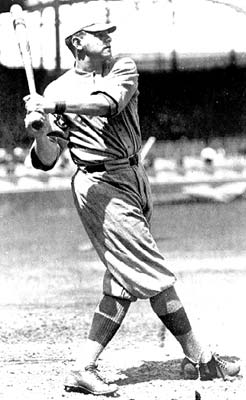
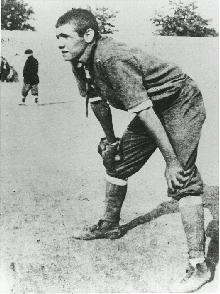
Baseball
was a popular and primary form of recreation for the boys at
St. Mary's. Young George Ruth, Jr., displayed his potential at
a very young age. He played all positions on the field, and
was an excellent pitcher. He also possessed a superb ability
to hit the ball. By his late teens Ruth had developed into a
major league baseball prospect. On February 27, 1914, at the
age of nineteen, Ruth was signed to his first professional
baseball contract by Jack Dunn, manager of the Baltimore
Orioles, at the time a minor league franchise in the
International League. Because Ruth's parents had signed over
custody of the youngster to St. Mary's he was supposed to
remain at the school until the age of twenty-one. To
circumvent this, Dunn became Ruth's legal guardian.
Jack
Dunn was well known for picking up youngsters whom he thought
had major league potential. When George Ruth, Jr., appeared
with Dunn at the ballpark the other players started cracking
jokes, and one of the players quipped, "Well, here's
Jack's newest Babe." The rest of the players also started
referring to young George as "Babe" and the name
stuck. Thus began the storied career of Babe Ruth."1
"In
1914, the Orioles were in first place, but they were losing
money. A newly formed league, the Federal league, had built a
new stadium and was outdrawing the Orioles. Dunn was forced to
sell Babe’s contract in order to stay in business.
Several
teams expressed interest in Babe, and on July 10, 1914, the
Boston Red Sox of the American League got him, along with
pitcher Ernie Shore and catcher Ben Egan. Just ten months
after leaving St. Mary’s, Babe would be starting his first
game in the Major Leagues."2
1George Beim and Julia Ruth Stevens’ book: Babe
Ruth: A Daughter’s Portrait
2The
Babe Ruth Birthplace and Museum (www.baberuthmuseum.com)








 Baseball
was a popular and primary form of recreation for the boys at
St. Mary's. Young George Ruth, Jr., displayed his potential at
a very young age. He played all positions on the field, and
was an excellent pitcher. He also possessed a superb ability
to hit the ball. By his late teens Ruth had developed into a
major league baseball prospect. On February 27, 1914, at the
age of nineteen, Ruth was signed to his first professional
baseball contract by Jack Dunn, manager of the Baltimore
Orioles, at the time a minor league franchise in the
International League. Because Ruth's parents had signed over
custody of the youngster to St. Mary's he was supposed to
remain at the school until the age of twenty-one. To
circumvent this, Dunn became Ruth's legal guardian.
Baseball
was a popular and primary form of recreation for the boys at
St. Mary's. Young George Ruth, Jr., displayed his potential at
a very young age. He played all positions on the field, and
was an excellent pitcher. He also possessed a superb ability
to hit the ball. By his late teens Ruth had developed into a
major league baseball prospect. On February 27, 1914, at the
age of nineteen, Ruth was signed to his first professional
baseball contract by Jack Dunn, manager of the Baltimore
Orioles, at the time a minor league franchise in the
International League. Because Ruth's parents had signed over
custody of the youngster to St. Mary's he was supposed to
remain at the school until the age of twenty-one. To
circumvent this, Dunn became Ruth's legal guardian.